
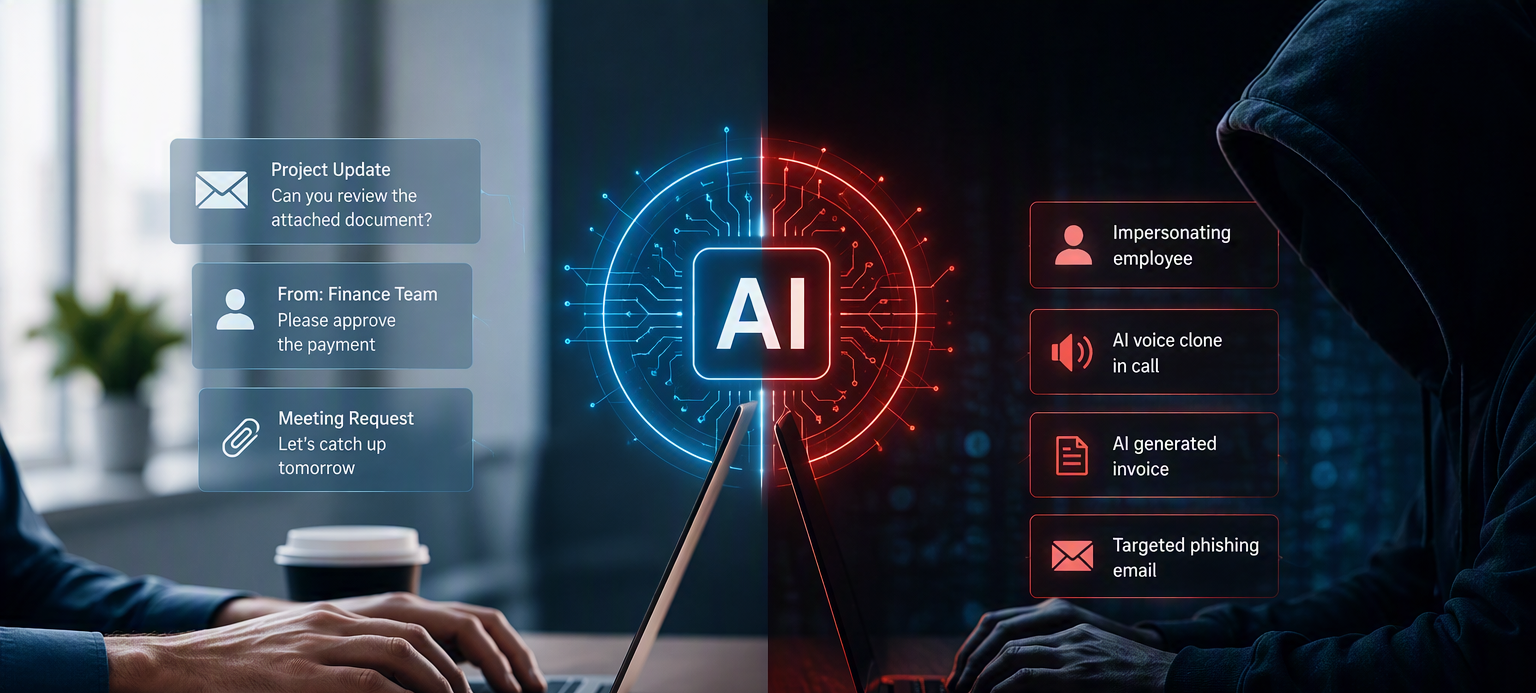
There’s no escaping AI at the moment.
Every day, we’re hearing about how artificial intelligence is helping businesses work smarter, automate routine tasks, and improve productivity. And to be fair, many of these tools can deliver real benefits when used correctly.
But there’s another side to the story.
The same AI tools helping organisations become more efficient are also helping cybercriminals become more effective.
The reality is that AI isn’t creating completely new cyberattacks. It’s simply making the attacks that already work faster, more convincing, and much easier to scale.
Phishing Just Got a Lot More Convincing
Not so long ago, phishing emails were often fairly easy to spot.
They contained spelling mistakes, poor grammar, strange formatting, or suspicious links. Employees were told to look out for those warning signs, and in many cases that advice worked.
Today, things are different.
AI can generate professional-looking emails in seconds. Attackers can use publicly available information to learn about your business, identify key employees, and create messages that look like they’ve come from someone you know and trust.
Instead of sending one generic email to thousands of people, criminals can now create highly personalised messages designed specifically for their target.
And that’s what makes them so dangerous.
It’s Not Just Email Anymore
One of the biggest concerns is how AI is improving impersonation techniques.
Voice cloning technology has become remarkably convincing, allowing attackers to create audio messages that sound like a manager, director, supplier, or colleague. AI can also generate realistic documents and content that would have taken significant time to create manually.
Imagine receiving a phone call from someone who sounds exactly like your managing director asking you to approve an urgent payment.
A few years ago that scenario would have sounded unlikely.
Today, it’s something organisations should be actively thinking about.
Why Identity Matters More Than Ever
Many cybercriminals no longer focus on breaking through technical security controls. Instead, they’re trying to gain access using legitimate user accounts.
If an attacker can steal a password, trick an employee into approving a login request, or gain access to an account through social engineering, they can often bypass many traditional security measures.
That’s why identity security has become such an important part of modern cybersecurity.
Strong passwords, multi-factor authentication (MFA), conditional access policies, and monitoring unusual activity are no longer optional. They’re essential.
Technology Alone Won’t Solve the Problem
When we speak with clients, one question often comes up:
“What security software should we buy?”
The honest answer is that there isn’t a single product that solves cybersecurity.
Good cybersecurity comes from a combination of people, processes, and technology working together.
You need the right technical controls, but you also need employees who understand the risks, policies that support good security practices, and leadership teams that take cyber resilience seriously.
Regular awareness training, tested backup solutions, incident response planning, and clear procedures all play an important role in protecting an organisation.
The Question Every Business Should Be Asking
Cybercriminals are already using AI.
That’s not a future prediction. It’s happening right now.
The question isn’t whether AI will impact cybersecurity. The question is whether your organisation is adapting quickly enough to deal with it.
Many businesses are embracing AI to improve productivity, which makes perfect sense. But as these technologies become more widely available, organisations also need to recognise that attackers are gaining access to the same tools.
Final Thoughts
AI has enormous potential to help businesses become more productive, efficient, and competitive.
Unfortunately, it also gives cybercriminals a powerful new advantage.
The phishing email that used to take hours to create can now be written in seconds. The fake invoice looks more convincing. The impersonation attempt sounds more realistic. And attacks that once required specialist knowledge can increasingly be automated.
That’s why cybersecurity strategies need to evolve alongside the technology.
Because AI isn’t replacing hackers.
It’s making them better at what they already do.
How Lithium Systems Can Help
At Lithium Systems, we help organisations stay ahead of evolving cyber threats through a combination of managed IT services, cybersecurity expertise, and ongoing strategic guidance. As a Cyber Essentials, Cyber Essentials Plus, and ISO 27001:2022 certified provider, we work with businesses to implement practical, effective security controls that protect users, systems, and data.
If you’d like to discuss how AI is changing the cyber threat landscape and what steps your organisation should be taking, we’d be happy to help.