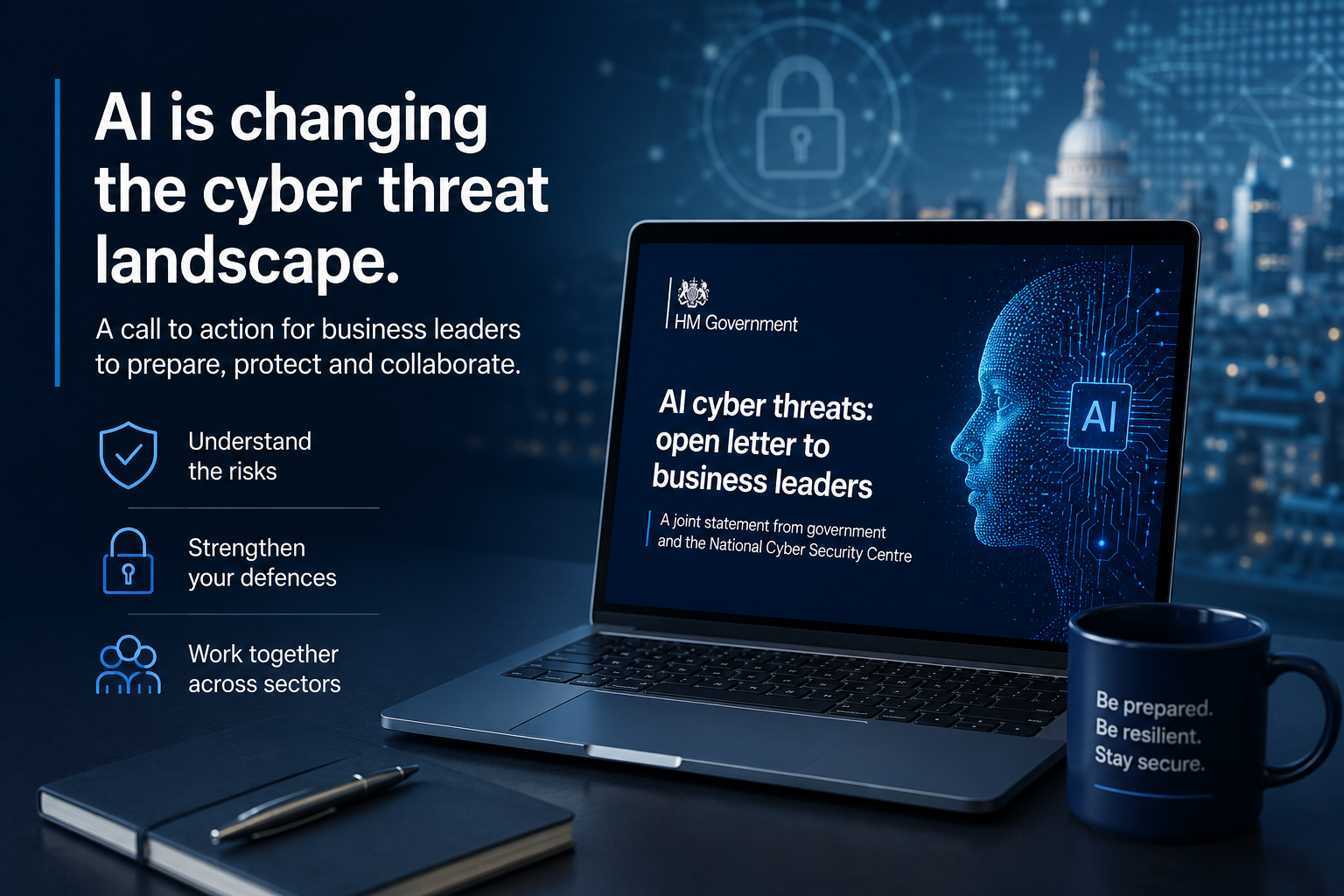
In April 2026, the UK Government issued an open letter to business leaders highlighting a significant shift in the cyber threat landscape driven by the rapid advancement of Artificial Intelligence (AI).

You can read the full letter here: 

AI cyber threats: open letter to business leaders

But what does it actually mean for your business?

Let’s break it down.


The Big Message: Cyber Threats Are Getting Faster, Smarter, and Easier to Launch

The Government’s message is clear: AI is lowering the barrier to cybercrime.

Historically, serious cyber attacks required highly skilled individuals. That’s no longer the case.

New AI models are now capable of:

  • Identifying vulnerabilities in systems
  • Writing exploit code
  • Automating attacks at scale

And they’re doing it faster than ever before.

In fact, government testing has shown that advanced AI cyber capabilities are doubling approximately every four months, highlighting just how quickly the threat is evolving.


This Isn’t a Future Risk – It’s Happening Now

One of the most important takeaways from the letter is that this isn’t a “future problem.”

AI is already being used to:

  • Create highly convincing phishing emails
  • Scan networks for weaknesses automatically
  • Accelerate cyber attacks across multiple organisations at once

This means attacks are not only more sophisticated, they’re more accessible.

Put simply: more attackers can do more damage, more quickly than ever before.


The Real Risk? Most Businesses Haven’t Fixed the Basics

Interestingly, the Government isn’t advising businesses to completely rethink cyber security.

Instead, the message is:

Get the fundamentals right and take them seriously.

Why?

Because attackers (AI-powered or not) are still exploiting the same common weaknesses:

  • Poor password practices
  • Unpatched software
  • Lack of backups
  • Weak access controls

AI simply allows criminals to find and exploit these issues faster and at scale.


Cyber Security Is Now a Board-Level Responsibility

A key theme in the letter is accountability.

Cyber security is no longer just an IT issue…it’s a business risk.

The Government is clear that:

  • Leadership teams must be actively involved
  • Cyber risk should be regularly discussed at board level
  • Organisations need clear governance and accountability

This reflects a broader shift we’re seeing across the industry where cyber resilience is now seen as critical to business continuity and reputation.


What the UK Government Recommends

The guidance is refreshingly practical. Businesses are encouraged to:

1. Take Cyber Security Seriously at the Top

Ensure leadership understands the risks and takes ownership.

2. Follow Recognised Frameworks

Use tools such as:

  • Cyber Governance Code of Practice
  • NCSC Cyber Action Toolkit

3. Get Certified with Cyber Essentials

This government-backed scheme protects against the most common attacks and significantly reduces risk.

4. Use NCSC Guidance and Services

The National Cyber Security Centre provides:

  • Free guidance and training
  • An Early Warning service to alert you of potential threats

5. Strengthen Your Supply Chain

Ensure your partners and suppliers are also meeting security standards.


What This Means for Your Business

For most organisations, the takeaway is simple:

The threat has changed but the solution isn’t complicated.

You don’t need futuristic AI defences to stay secure.
You need:

  • Strong foundations
  • Consistent processes
  • Regular review and improvement

Businesses that already have good cyber hygiene in place will be far better positioned to deal with AI-driven threats.

Those that don’t… are now significantly more exposed.


Final Thoughts

The Government’s open letter isn’t trying to alarm businesses, it’s trying to wake them up.

AI is transforming cyber security at unprecedented speed, and while it brings huge benefits, it also introduces new risks that can’t be ignored.

The key message is this:

Cyber resilience is no longer optional and AI is accelerating the need to get it right.


How Lithium Systems Can Help

At Lithium Systems, we work with businesses across Scotland and the UK to:

  • Strengthen cyber security foundations
  • Achieve Cyber Essentials certification
  • Implement practical, cost-effective security controls
  • Provide ongoing monitoring and support
  • Protect businesses using the leading providers of Cyber Security, Email Protection and Backup

If you’d like to understand how prepared your business is for the new AI-driven threat landscape, we’re happy to help.

Each asset has an associated cost, and you want to maximize any investment by ensuring that equipment is being used properly by the right people. Asset management is also a key component of overall risk management as it ensures that your business only uses supported and compliant devices.

Single Order Generic Ethernet Access, or SOGEA for short, is a type of broadband internet connection that provides a dedicated Ethernet connection directly from a customer’s premises to the internet service provider’s (ISP) network.

SOGEA allows customers to connect to the internet using only a single order, which includes both the broadband service and the telephone line rental. This means that customers can use the same telephone line for both voice calls and internet access, without the need for a separate Openreach phone line.

One of the benefits of SOGEA is that it can provide a faster and more reliable connection than traditional broadband options such as ADSL, which rely on copper telephone lines. SOGEA is also a good option for customers who don’t need a traditional phone service, but still require high-speed internet access.

SOGEA is currently available in the United Kingdom, and it’s expected to become a more widely used broadband option as more internet service providers adopt it.

Starlink internet is a revolutionary new way to connect to the internet that is fast, reliable, and available virtually anywhere in the world.

With Starlink, you can say goodbye to slow, unreliable internet connections and hello to high-speed internet that delivers download speeds of up to 100 Mbps. Best of all, Starlink uses advanced satellite technology to provide internet access to areas that are traditionally underserved or completely without internet access. Whether you’re living in a rural area, traveling on the road, or just tired of slow internet speeds, Starlink has the solution you’ve been looking for.

Our leased line product is a dedicated, private telecommunications circuit that provides a direct and continuous connection between two points, typically used for internet access, voice communications, or data transfer.

One of the main benefits of a leased line is the reliability and consistency it offers, as it guarantees a fixed bandwidth and symmetric upload and download speeds, without sharing with other users. This makes it ideal for businesses that require high levels of connectivity and bandwidth, such as those that use cloud services or require large file transfers. Additionally, our leased lines offer improved security, as they are not vulnerable to interference or hacking from external sources, unlike shared broadband connections. Lastly, leased our lines come with a service level agreements (SLAs), which provide guarantees for uptime and response times, ensuring a high level of customer service and support.

Ethernet First Mile (EFM) is a technology that enables high-speed, dedicated internet access over traditional copper-based infrastructure. Specifically, EFM refers to the use of Ethernet technology to provide connectivity from a customer’s premises to the service provider’s network.

In traditional broadband access, a customer’s connection to the provider’s network typically involves a shared medium such as cable or DSL. With EFM, the customer’s connection is dedicated, meaning that they have a direct, uncontended connection to the provider’s network.

EFM is often used to provide high-speed internet access to small and medium-sized businesses, as well as remote or underserved areas. It can offer speeds of up to 35 Mbps over distances of up to 10 kilometers, depending on the quality of the copper infrastructure.

Overall, EFM is a cost-effective solution for businesses that require reliable, high-speed internet connectivity but cannot access fiber-based solutions due to geographical or economic limitations.

FTTC stands for Fiber to the Cabinet, which is a type of internet broadband technology. It involves running a high-speed fiber optic cable from the internet service provider (ISP) to a street cabinet, which is usually located on the side of a road or a pavement, and then using the existing copper telephone lines to connect homes and businesses to the cabinet.

The distance between the cabinet and the property can affect the speed of the internet connection. The closer the property is to the cabinet, the faster the internet speed.

FTTC can provide faster internet speeds compared to ADSL (Asymmetric Digital Subscriber Line) technology, which uses copper telephone lines for both download and upload data. FTTC can offer download speeds of up to 80 Mbps (megabits per second) and upload speeds of up to 20 Mbps, depending on the quality of the copper telephone lines and the distance between the property and the cabinet.

FTTC is often used as an interim solution while ISPs work on providing full fiber connections to homes and businesses.