
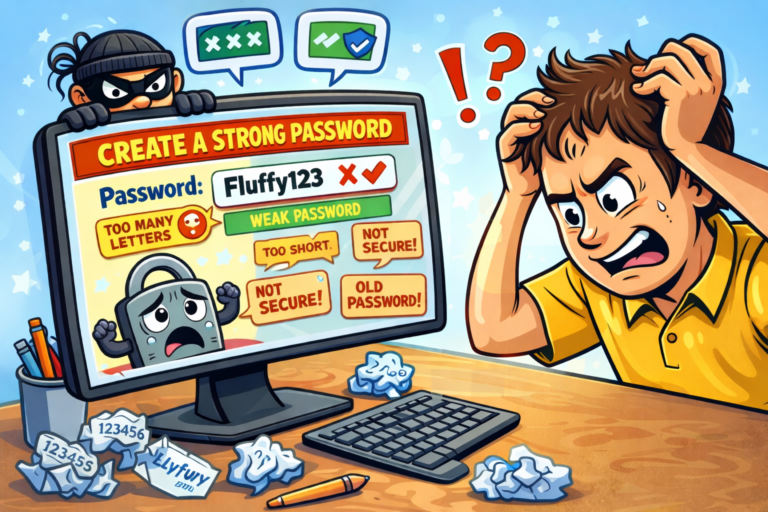
If you’ve ever spent 15 minutes crafting the perfect password, sprinkling in capital letters like Parmesan cheese, adding special characters for flair, and maybe even throwing in the name of your childhood crush! We’ve got news for you…
According to Microsoft’s identity security team, your beautifully crafted “L0ngEr&Str0ng3r!” password isn’t impressing anyone… Least of all cybercriminals. In fact, they don’t care about its length, creativity, or emotional backstory. They’re not here to admire your work. They’re here to steal it.
So let’s talk about why your password mostly doesn’t matter — and what actually does.
Attackers Don’t Break Passwords — They Steal Them
Microsoft defends against hundreds of millions of password‑based attacks every single day. Let that sink in. That’s more attacks than cups of tea consumed in the UK on a rainy Tuesday. And the most common attack methods?
Not Hollywood-style supercomputers crunching through trillions of combinations.
Nope. It’s the classics:
Credential stuffing
Hackers take passwords leaked in other breaches and try them on your accounts. Since 62% of people reuse passwords, attackers often already have the exact password they need. No guessing required.
Phishing
That “Your Package Is Stuck at Customs, Click Here” message?
Yes, those — 2% of all inbound emails are phishing attempts, and whilst that seems small, it equates to 4.5 billion malicious emails a day, all politely asking users to hand over the password yourself.
Keystroke logging
Some malware simply watches what you type. Even your 16‑character masterpiece isn’t safe from that.
In short: attackers don’t break your passwords… they trick, borrow, recycle, and swipe them.
So Why Bother With a 16‑Character Password?
Because while your password mostly doesn’t matter to attackers, it matters to you.
A long (16+ character), easy‑to‑remember password, reduces the chance of a brute‑force attack and keeps you safer from opportunistic attacks. Think of it as locking your front door; it won’t stop a tank, but it’ll stop a casual chancer.
Our recommendation?
Use a long passphrase you can remember. Something silly but personal:
- CorrectHorseBattery2020#
- 123TeaAndBiscuitsForever!
- MyDog8MyLastPassword:-(
If it makes you laugh, even better. You’ll remember it!
The Real Hero: Multi‑Factor Authentication (MFA)
This is the part where we stop joking and start shouting.
Microsoft’s research, and the wider security community, is unequivocal:
MFA stops over 99% of account‑takeover attacks.
That’s because even if attackers steal your password (see above), they cannot:
- Steal the code on your phone
- Copy your biometric scan
- Clone your hardware key
- Intercept your authenticator app approval (unless you approve it… please don’t)
Think of MFA as the “nightclub bouncer” of the cybersecurity world:
Password alone says, “He’s with me.”
MFA says, “Prove it.”
And attackers absolutely hate being asked to prove things.
The Bottom Line
You don’t need to agonise over special characters or obscure password rules. But you do need:
 A long, memorable password (16 characters is ideal)
MFA enabled on every account that matters (that’s all accounts…)
 A false sense of security because your password contains “$” instead of “S”
Cybersecurity doesn’t have to be dry, boring, or complicated — but it does need to be taken seriously.
Think of this post as your friendly reminder to shore up your digital defences.
And if you’re not sure how to enable MFA for your business or need help improving your security posture, we’re only an email away.
Stay safe — and for the love of security, stop reusing your password from 2012.